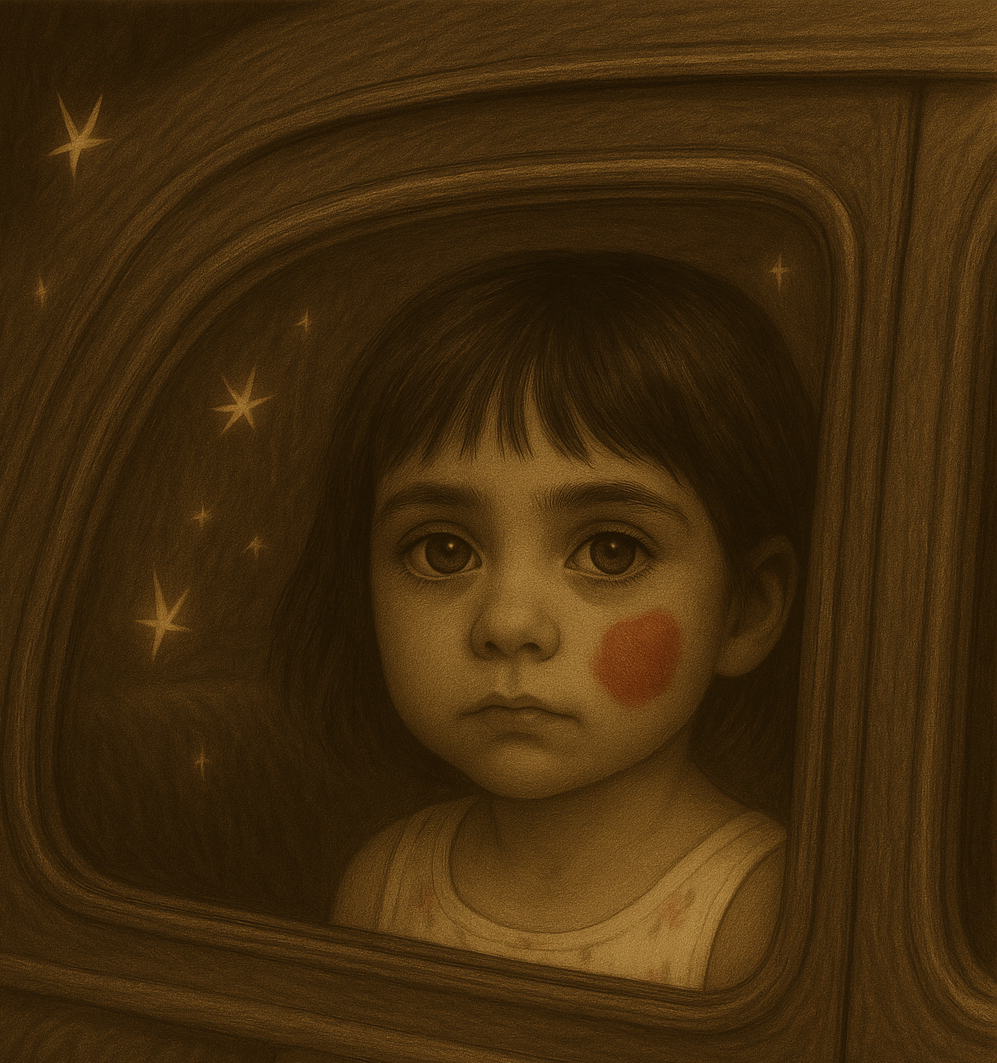
Daddy rubbed that castor oil on her chin every night, praying the mark would disappear.
In a crumblin’ house in Estill County, a little girl named Puddin’ waited for magic in the only place she could still find it: the motes of dust that danced like fairies in thin blades of sunlight.
Since Little Mammaw left, those fairies were her only friends. They listened when no one else did. They never called her names.
When Daddy finally came home, his railroad boots hit the porch like a thunderstorm.
The arguing started before he even crossed the threshold—those same sharp voices that always rose when he’d been drinkin’ or when Mother had been thinkin’ too long about that Regina woman in town.
Words turned to screams.
The blue roses on Mother’s dress whipped across the room as she chased him. Puddin’ pressed a finger to the bright red birthmark on her chin and whispered, “I’m gonna need a bunch more castor oil tonight.”
Daddy rubbed that castor oil on her chin every night, praying the mark would disappear. He called it her beauty mark and kissed her forehead as he rubbed. Mother hated it.
Puddin’ told the fairies how Mother and big sister Nancy locked her out of the bedroom because she “wasn’t pretty like them,” how Mother hissed, “Go away, you witch child.”
The fairies loved her anyway.
The fight tumbled toward the fireplace mantel, where Little Mammaw’s photograph ruled the house: Mother in black-and-white, young and beautiful, forever smiling. The color copy—bright and dangerous—had vanished the day Little Mammaw fled to Northern Kentucky. This sparkly-framed shrine was all that remained.
Daddy snatched it.
Mother turned wild—hands like claws, draggin' bloody rivers down his cheek. A brave fairy tried to wipe the blood away and only smeared it worse. Daddy saw Puddin’s wide eyes on the red marks. Something inside him split open.
He slammed the frame against the edge of the mantel.
Glass burst and flew. Tiny cuts opened along Puddin’s legs; the fairies bled with her, red pinpricks blooming across invisible wings.
Daddy drew the pistol from the back of his waistband. Mother lunged.
Thud.
The butt of the gun met her skull with a sick, wet crack. She fell. Blood threaded through her dark curls and pooled in her hand.
Puddin heard Little Mammaw’s voice—hands waving at the sky like always: “Sweet Jesus Christ of Nazareth… Lord, make them stop actin’ ugly.”
Daddy scooped Puddin up so hard her ribs creaked. Mother clawed at the floorboards, screaming his name—“Walter Earl! Stop!”—but the front door was already slamming behind them.
He set her in the back seat of the Hudson.
Through the rear windshield, she watched the blue roses on Mother’s dress grow smaller… smaller… gone.
Puddin looked down at her own dress, blood drops soaking between the pink roses—and at the tiny cuts glittering on her shins like rubies the fairies left behind.
The Hudson tore up the dirt road in a choking yellow cloud. A swarm of wounded, furious fairies chased after them—shrinking to specks, then to nothing.
Puddin never saw the Big Ol’ House again.
Some say the fairies stayed behind, guarding the broken glass and the blood-stained mantel, waiting for a child who would never return.
But sometimes, on certain backroads at dusk, drivers swear a swirl of dust rises beside an old Hudson that isn’t there anymore— and inside it, a little girl with a red mark on her chin, pressing her face to the window, her big eyes saying goodbye.
***